
Key Takeaways
CRO extracts more revenue from existing traffic without a single euro of additional advertising budget.
Even a +0.5 percentage point increase in conversion rate can mean five-figure additional revenue per month.
The process: analyse the customer journey, find weak points, validate hypotheses via A/B testing.
In addition to the conversion rate, always measure AOV, cart abandonment rate and ROAS, otherwise you will optimize past your goal.
Introduction
More visitors do not automatically mean more revenue. Perhaps you are familiar with this: traffic to your website is increasing, but sales are falling short of expectations. This is exactly where Conversion Rate Optimisation (CRO) comes in.
CRO is the lever to get more customers, enquiries, or sales out of existing traffic, without additional advertising costs. And best of all: even small improvements can have enormous effects on your revenue.
What is Conversion Rate Optimisation?
Conversion Rate Optimisation means increasing the percentage of visitors who perform a desired action. This action can be a purchase, a newsletter sign-up, or filling out a contact form.
The goal: Generate more revenue from existing traffic.
Formula: Traffic × Conversion Rate × Average Order Value = Revenue
An calculation example:
10,000 visitors per month
2% Conversion Rate
€50 average shopping basket
= €10,000 revenue. If you increase the conversion rate to just 3%, revenue immediately jumps to €15,000, and all without any additional marketing budget.
Why is CRO so important?
Many businesses invest a lot of money in advertising to attract new visitors. But if the website does not convert, a large part of this budget goes to waste.
CRO is the bridge between traffic and revenue. At the same time, it takes into account the psychology of buying:
Building trust (reviews, trust badges, security)
Providing guidance (clear CTAs, structured pages)
Removing barriers (simple checkout processes)
How does Conversion Rate Optimisation work?
CRO is a systematic process:
Analysis of the Customer Journey: Where do users enter, where do they drop off?
Identify weak spots: e.g. high shopping basket abandonment or unclear CTAs.
Develop and test measures: Set up hypotheses, conduct A/B tests, evaluate results.
Enjoy more revenue.
Overview of CRO Methods
A/B testing and multivariate testing: With A/B testing, you compare two variants of a page or an element, for example, button colour or headline. Multivariate testing tests several elements simultaneously. Example: Shop A tests two Call-to-Action buttons: "Buy now" vs. "Add to basket". Variant B achieves 12% more clicks.
Usability optimisations: Good usability reduces purchase abandonment. The easier customers can find what they are looking for, the higher the conversion. Example: A furniture shop replaces a long checkout form with a 2-step process. Result: 18% fewer shopping basket abandonments.
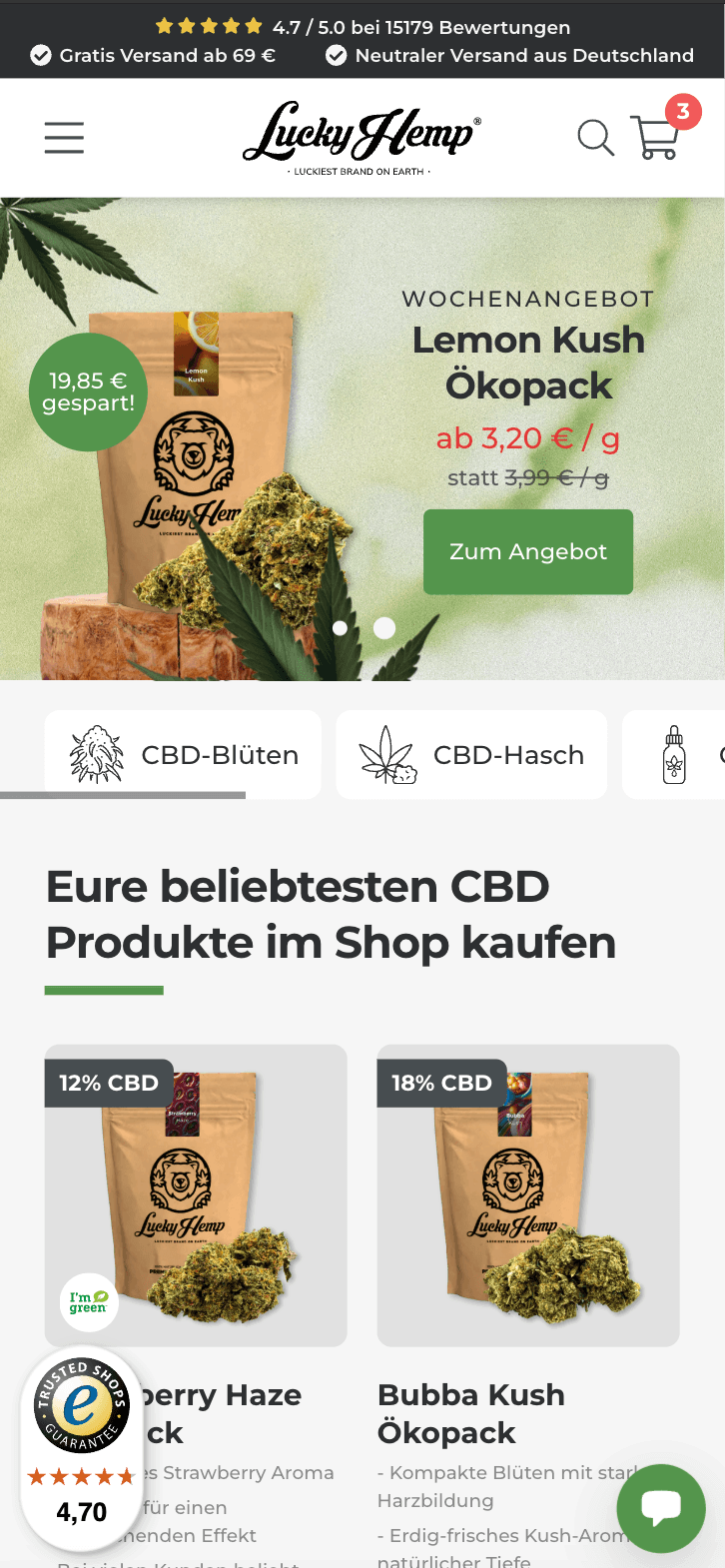
Trust elements: Quality seals, genuine reviews, and clear information on shipping and returns increase credibility. Example: An electronics shop integrates the Trusted Shops seal and shows reviews directly on the product page. The conversion increases measurably.
Mobile optimisation: More than half of all online purchases are made on mobile. Example: A fashion shop optimises its product pages for thumb operation with large buttons and fast loading times. Result: 25% more mobile sales.
Technical factors: Fast loading times and barrier-free design lower the bounce rate. Since 28 June 2025, the Accessibility Reinforcement Act (Barrierefreiheitsstärkungsgesetz) has also been in force. Example: A retailer reduces image sizes and uses a CDN. The loading time drops from 4 to 1.5 seconds and conversions increase significantly.
Funnel Alignment: All touchpoints should be coordinated with each other, from the advert to the checkout. Example: A cosmetics shop aligns Facebook ads, landing pages, and checkout pages with each other, using the same colours, tone of voice, and offers. Result: more completed purchases.
Key Performance Indicators (KPIs) in CRO
Conversion Rate (CR): Core metric.
Shopping cart abandonment rate: Shows weaknesses in the checkout.
Average Order Value (AOV): Revenue per order.
Customer Lifetime Value (CLV): Value of a customer over the entire relationship.
Bounce Rate & Session Duration: Provide insights into relevance and user experience.
Return on Ad Spend (ROAS): How profitable paid advertising campaigns are.
Strategies to increase order value
Cross-selling ("You might also like this"): You suggest matching items alongside the main product. Example: Smartphone in the shopping basket: a case or charger is suggested.
Upselling (Premium variants): Instead of a "Basic subscription": "Premium subscription". Psychological trigger: Customers want "the best" for their money.
Bundle offers & volume discounts: Example: "Skin-care set" instead of individual creams: higher shopping basket value.
Minimum order values for free shipping: Example: AOV is €45, the threshold for free shipping is €60: customers deliberately add more to their basket.
Personalised product recommendations: Example: A loyal customer for sportswear is specifically suggested matching shoes.
How much extra revenue does CRO really bring?
A small increase in the conversion rate has a disproportionate effect on revenue. Example:
Initial situation: 2% CR, €100,000 revenue/month
New CR: 2.5%
Result: €125,000 revenue/month: +€25,000 without additional marketing
And every euro spent on marketing is now worth 25% more because more customers are buying.
Costs of Conversion Rate Optimisation
Conversion optimisation can be carried out internally or with an agency. This results in either ongoing costs for continuous testing or one-off project costs. It is important to consider the Return on Investment (ROI). Example: A measure costs €5,000 but permanently increases monthly revenue by €20,000.
Difference: CRO vs. Shop Optimisation
CRO: Leverages revenue from existing traffic.
Shop Optimisation: Technical basis (design, performance, loading time).
Unbeatable together: Sustainable growth can only be achieved with both components.
Other success factors
Understand user psychology and behaviour
Use colours, layouts, and Call-to-Actions in a targeted manner
Utilise social proof (customer reviews, testimonials)
Clarity and simplicity in the checkout
Content & Storytelling as a CRO Lever
Nowadays, as a brand, you cannot do without content and storytelling; it is the ultimate tool of online marketing. Above all, high-quality visuals (and videos) and persuasive product descriptions that build trust are key.
Conclusion
It is very important to lay the foundations for a good conversion rate on your online shop. Conversion Rate Optimisation is a continuous process, not a one-off project. Anyone who regularly tests, optimises, and improves benefits in the long term from:
more revenue
more efficient use of the marketing budget
happier customers
💡 CTA for you: You can request an audit of your website from us, and we will look at how to make your shop even more effective.
You want to know what your shop delivers daily leaves behind?
An actionable CRO lever in your inbox every week?
SubscribeWhere do you start with CRO without getting bogged down?
Right where the most revenue is lost: on the path with the highest traffic and the biggest drop-off, usually between the product page and checkout. Do not optimise based on gut feeling, but on data.
A simple prioritisation helps to tackle the right tests first: evaluate every idea by its expected impact, confidence in the assumption, and effort. This way, the measures with the best ratio end up at the top.
Where to find the leaks:
Funnel analysis: at which step do most users drop off?
Session recordings and heatmaps: where exactly do users struggle?
Short surveys: what prevented the purchase today?
💡 Pro-tip: Start with the step directly before the money. An improvement in the checkout immediately impacts revenue, whereas optimisations at the very top of the funnel often take much longer to filter through.
How do you prevent your A/B tests from deceiving you?
By defining a clear hypothesis and the required sample size before starting, and never stopping a test prematurely on a good day. Otherwise, you are measuring randomness instead of impact.
The most common misconceptions in testing:
Deciding too early because one variant is briefly ahead
Testing multiple changes simultaneously and not knowing what worked in the end
Testing over too short a period and overlooking day-of-the-week effects
Only measuring the conversion rate, even though revenue per visitor is the more honest metric
⚠️ Common mistake: A test running for three days with 200 visitors does not yield reliable results. Calculate the sample size beforehand and let the test run for full weeks.
You want to know what your shop delivers daily leaves behind?
Want to know where your shop is leaving revenue on the table? We'll find out with a free CRO audit.
Request a CRO auditHow do you start with CRO this week?
With a 60-minute funnel teardown: walk through your own purchasing process step-by-step and write down every point of friction. Ideally once on desktop and once on mobile.
The concrete roadmap:
Extract the conversion rate and drop-off points of the last 90 days from your analytics
Mark the step with the biggest drop-off as the first test candidate
Formulate a single hypothesis (If we change X, then Y will increase because of Z)
Set it up as an A/B test over a full two-week period, with Revenue per Visitor as the leading metric
CRO is not a one-off project, but a routine. Those who test regularly and document the losers just as much as the winners will extract more revenue from identical traffic, month after month.
Let us talk about yours Talk about the funnel.
15 minutes, free of charge: we will take a look at your shop together and you will leave with at least one concrete test suggestion.
Choose appointmentWhat is a good conversion rate in e-commerce?
Depending on the industry and traffic quality, typical values lie between 1 and 4 per cent. More important than the industry comparison is your own development and the potential: going from 2 to 2.5 per cent already means 25 per cent more revenue.
How quickly will I see results from CRO?
Initial valid test results are usually available after two to four weeks, depending on traffic. However, CRO is a continuous process; the effect adds up test after test.
How much does conversion optimisation cost?
That depends on the scope: an ongoing testing programme or a one-off project. The decisive factor is the ROI; a measure costing €5,000 that permanently brings in €20,000 in monthly revenue pays for itself in days.
What is the difference between CRO and SEO?
SEO brings more visitors to the site, CRO turns existing visitors into customers. Together, both represent the most efficient path to growth; CRO makes every SEO and Ads Euro more valuable.
For years, Jonas has been optimising shops for conversion — with data-driven A/B testing for over 103 e-commerce brands like LuckyHemp and Alb-Filter. At SCAEL, he is responsible for strategy and testing.
Auf LinkedIn vernetzen